My Story Part 3: 7-14 Years Old.
I know my biggest problem in life is my memory; everything else seems to be going okay! As mentioned, my first seven years were spent at Priesthaugh Farm. I do have memories of the farm, but I’m not sure how many, if any, I lost through the cycling accident. The accident was thirteen years ago, and I don’t know what I remember from those first seven years, before the accident.
I remember climbing one of Dad’s hills one day with Mum and my sisters. At the top of the hill, we met a neighbour from the adjoining farm that we knew; no texts or phone calls, just a long warm walk and a chat over the dyke, and I know it was more luck than judgement or arrangement, but that’s what happened.
Other memories were of watching Dad send his working collies what seemed like miles to bring the sheep in, probably a few hundred yards, but memories make it seem farther. I remember part of the chores were milking the cow(s) that Dad had as part of his deal with the farmer, getting free milk for the family, and then selling the livestock when ready for much-needed income. The milk came from manual milking into a bucket; it was drained through a cloth into another container, left to cool, and used. None of the processes that are used today, and here I am 63 years later, alive and well to tell the tale!
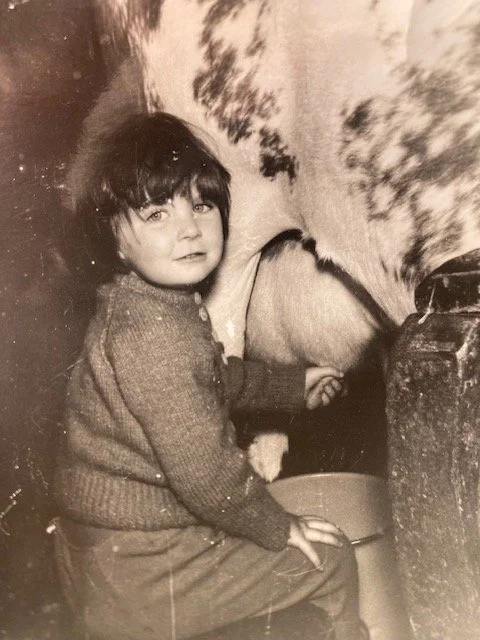
(Poser or worker, as she grew older I realised she was a worker?)
There aren’t many photos from back in the day, but we have this one, my younger sister milking Dad's cow (or trying, maybe just posing, knowing the photo would be used in years to come!) her being maybe aged 5/6 years old. I wonder how many kids that age can say they had chores like this to do.
In those days shepherds didn’t receive a good wage. There was always a free house; usually a supply of coal; upkeep for the dogs, an essential tool of the trade even to this day; and an agreed number of livestock, which all added to the contract between farmer and shepherd and were all part of his income.
Some got more, some maybe a little less; on that subject, I’m sorry I can’t tell you, but what I can show you is a picture from my cow-milking sister of an original contract of employment for my Dad. Written in October 1962, a few months before that terrible winter and the birth of his son – that’s me! Apologies, but when I was writing about his benefits, I missed out on the possibility of potatoes, probably ones grown on the farm further down the road; I can’t remember.
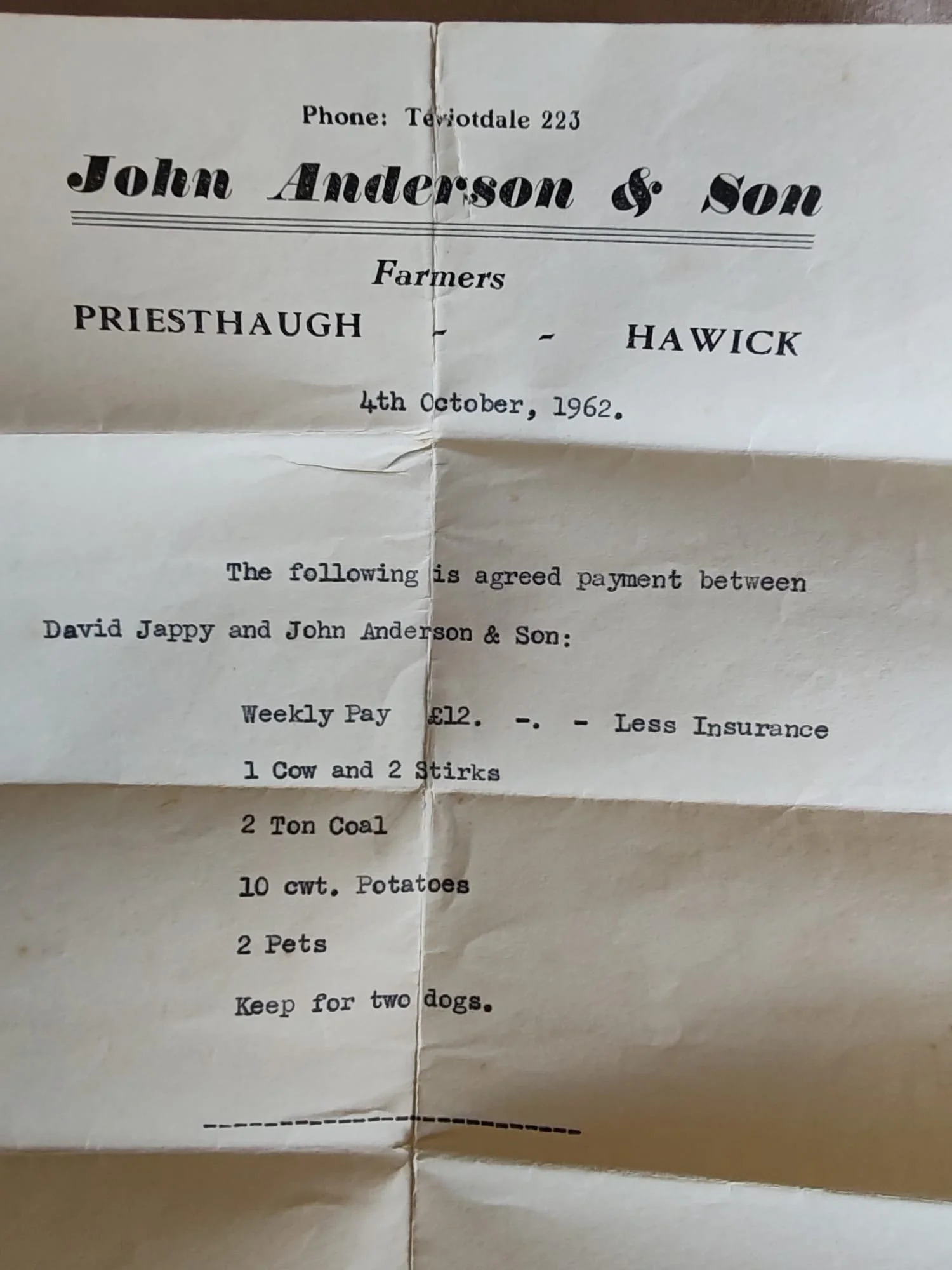
(£12 per week - it’s more than that per hour nowadays for sitting in a comfy chair, with central heating and a coffee machine :-) )
(Look at the phone number - 3 digits)
The other main story from Priesthaugh was that Dad nearly died whilst working, not through any industrial accident, but through duty to the job, and I can only assume it was the winter of 1963; it was that bad. So, this could have been before or after I was born, and so I was possibly not even there when it happened, but definitely too young to remember if I was.
With the bad winter, the snow was deep and drifted badly with the wind. Sheep would look for shelter against the dykes and trees, or anywhere they could, and they would often get caught in the drifts during the nights, and the shepherds would be out in the morning looking for the sheep; after all, it was their responsibility, and in those days, weather didn’t matter; it was part of the job, you just got on with it.
If I remember the story, Dad had gone out looking for some of his flock and had pretty much been out all day. He was freezing cold, and when he got home, he realised his dog hadn’t followed him, and he couldn’t lose his dog, and by the time he had gotten home, he had become confused and disoriented. Mum wanted him to get into the house and get warmed up to recover, but remember the important tool of the trade, the dog, so he went back out to look for it.
He found the dog and somehow made it home, probably lucky for Dad; with Mum being a nurse, she knew exactly what to do. Frozen and wet clothes off, warm ones on, wrapped in blankets and lying him down in front of the roaring fire, her cuddling up beside him to add to the heat going into his freezing cold body. What a couple, and a marriage that was to last over 63 years! It would only have been about 4 years had Mum not acted as she had that day. God forbid she had been away at her mum’s in the local town, as she was for my birth!!
In 1969/70, Dad moved to what I believe is called a ‘hirsel’ named Lairhope, the hills and sheep part of a farm called Falnash, near Teviothead. The latter is a collection of a few houses on the A7, the Carlisle to Edinburgh Road. One of my clearest memories of living here was occasionally having to walk (usually) home from the main A7 at Teviothead after being dropped off by the school bus, which took us to and from the Hawick schools, some 9 miles away.
It was never a problem in those days, as it was only a 2-mile walk for us! Although I’m sure the first thing I looked for when approaching the bus stop on the way home from school was our parents’ car! And I must admit there would have been times it wasn’t there; I must have become a touch despondent, but we just walked, as again, in those days that is what we did - no sitting around with a mobile trying to contact Mum or Dad to ask where they were. Mobile phones wouldn’t become ‘popular’ for about another 25 years or so. Occasionally that despondency became a smile, as no sooner had we started walking than the white Volkswagen Variant estate GUW 944J would come down the country lane towards us, often late, always caring.
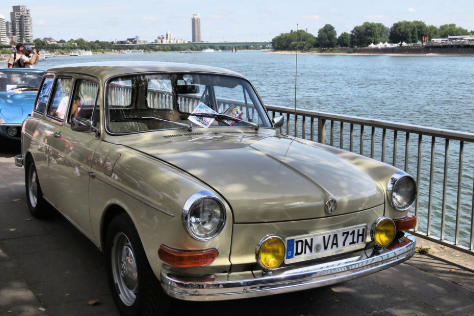
(Who remembers the Volkswagen Variant? Often my saviour.)
"Volkswagen Variant L, 1971" by linie305 is licensed under CC BY-NC-SA 2.0.
I have mentioned comparisons to today’s society, and with that I can tell you about a family in Broseley where I worked, who drove their children some 3/400 yards to their primary school. When my work colleague told me the story, I assumed he was telling some porkies, but he wasn’t. Work was right beside the school, and when I told him I didn’t believe him,
I was outside working one morning when he came out of his office and showed me the car dropping the kids off. I often walked up to town at lunchtime, and he told me to look up a side street to my left, and I would see the distinct 4x4 parked on a drive, and sure enough, the next time I went, there it was, parked on the drive, just those 3/400 yards away from the school.
I appreciate we can’t be too judgemental as the children may have had problems; however, the time my colleague took me out to watch the car at the school and prove his point and his honesty, the kids jumped out of the car and ran into school without a problem.
So, 2 miles to catch the bus and a 9-mile trip meant a round trip of 22 miles each day to get to school, but we weren’t the furthest. There were children on the bus who lived near Linhope; in fact, that could have been the name of the farm, and I believe it was a 28-mile round trip; however, it was still not the furthest, as children from Newcastleton used to attend the school in Hawick, and that is a round trip of 40 miles – not much fun on any day. And for all I know, there could have been children who travelled further. And in some of the more remote regions there will surely be children travelling even further.
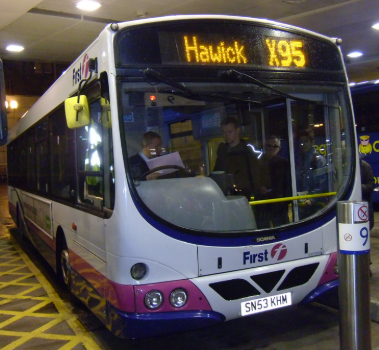
(If only our buses had been this modern; the diesel fumes from the engine compartment beside the driver, along with the then-winding road, often made me feel sick, something that still affects me today. Being a passenger, that is, not the diesel fumes!)
"The Hawick Bus" by cessna152towser is licensed under CC BY 2.0.
And I will tell you at this stage, it was our choice. Just after moving to Lairhope, I remember Mum & Dad getting us together and asking us if we wanted to carry on going to the school in Hawick, where we were settled with friends, or if we wanted to attend the small community school at Teviothead.
We chose Hawick, as I don’t think any of us wanted to start a new, albeit small, school all over again. I’m glad I did, as I became the school rugby team captain when I first learned to play the sport at Drumlanrig Primary School; they didn’t play at the Teviothead school, which I’m sure my Dad mentioned to me and was another deciding factor. At Drumlanrig I was taught to play the game by the ex-BBC rugby commentator, Bill McLaren, who taught at all the schools in the town. He was a giant of a man to us smaller children and towered over us.
I think a lot of the respect we gave him was because of his height, but he was also a good teacher and taught me how to play rugby. I have mentioned having few regrets in my writing so far, but one regret I do have is not playing more rugby. Not concentrating on it when I was younger and not playing more in my older years, but that could also be a story in itself.
As I was growing older, helping dad out with his work increased. In a shepherd’s life, certain things happen every year at the same time. Lambing was normally around March & April, with many fatalities if it was a bad, long winter.
Shearing was soon after, then it was ‘spaining’ or ‘weaning’ the lambs, which usually happened not long after that, and there was a lot of work involved just within these three aspects of the work cycle. As kids we had to help, and it was not my favorite work, I must admit, and something I will go into in time, maybe with my rugby story.
But we did it, and I believe a part of growing up as a shepherd's child - it wasn’t just me; as the milking of the cow shows, we all got stuck in, doing bits here and there. If my memory does serve me, I’m sure my friends from the farming community did just the same, and like the rest, some of these stories will continue.
Thanks for reading
DJ